Fire escapes · Inspection & certification
Fire Escape Inspection & Five-Year Certification
Short answer: Every five years, someone qualified has to examine (and, where needed, test) each fire escape and certify it, and the affidavit goes to your city's building department. In Boston that person is a registered professional engineer or a licensed fire escape installer; King Iron Works is a licensed fire escape installer. If anything fails, it is repaired and re-checked before the affidavit is filed.
What the rule says
The statewide requirement comes from the State Building Code. Cities add their own forms, permits and fees.
Massachusetts
The State Building Code (780 CMR) requires existing exterior fire escapes, egress balconies, exterior stairways and bridges to be examined and/or tested, and certified, every five years. The certification is an affidavit filed with the local building official.
Source: City of Worcester: Certificate of Inspection Program (Table 110)
Boston
Inspectional Services says all fire escapes must be re-certified every five years by a Massachusetts registered professional engineer or a licensed fire escape installer. Repairs to an existing fire escape go under a Short-Form Permit; a new fire escape needs a Long-Form Permit.
Cambridge
Cambridge Inspectional Services takes the five-year certification on its own fire escape and fire balcony affidavit form, with its own filing fee.
Source: City of Cambridge ISD: Fire escape and fire balcony affidavit
Worcester
Worcester's Certificate of Inspection program for apartment buildings (R-2, three or more units) lists fire escapes, exterior porches, egress doors and stairways among the things its inspector looks at.
Source: City of Worcester: Certificate of Inspection Program (Table 110)
Check the current form and fee with your city before filing. Boston's certification page: boston.gov.
What gets checked
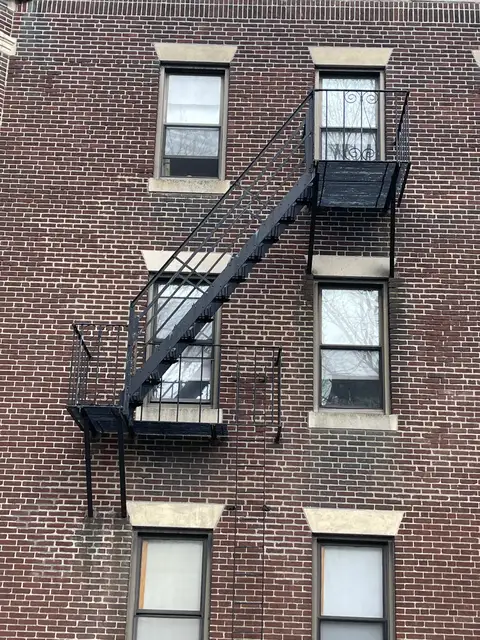
An inspection covers the whole fire escape, top to bottom, plus how it is held to the building.
Anchors and brackets
- Each bracket and anchor where it enters the wall
- Cracked, loose or missing brick and mortar around anchors
- Bolts and rods: section loss, missing nuts, rust-jacking
Platforms and balconies
- Grating or bars: rust-through, bends, missing pieces
- Frames and angles: sag, cracks, failed welds
- Connections between platforms and the stair
Stairs
- Stringers: rust, cracks, bends
- Treads: loose, cracked or missing
- How the stair is fastened at top and bottom
Guards and handrails
- Loose posts and rails
- Missing or broken pickets
- Rails that pull away under hand pressure
Drop ladder or counterbalanced stair
- Slides freely through its guides
- Hooks, stops and counterweight hardware in place
- Nothing parked or built under it that would block it
Getting onto it
- Windows and doors to the fire escape open from inside
- Platforms clear of grills, plants, storage and AC units
- Window gates (if any) release from inside without a key
Examined and/or tested
The code's wording is "examined and/or tested." Most of an inspection is close examination: hands on the steel, a hammer on suspect members, a look behind the brackets. Where a part's strength can't be judged by eye, the inspector can test it, for example by loading a platform. We'll tell you before the inspection if we expect anything on your building to need a test, and what that involves.
The result is a written list of findings with photos. A fire escape that passes gets its affidavit. One that doesn't gets a repair list, and the affidavit waits until the repairs are done and checked.
How a certification goes with us
- 01
Book a time
We set a date and tell you which windows or doors we need to get through. Tenants usually only need to unlock one window per floor.
- 02
Inspect and photograph
Every level and every connection, with photos of anything we flag.
- 03
Written findings
Pass, or a list of repairs. Each repair is described plainly and priced separately.
- 04
Repairs, if needed
Done by our crew, with parts made in our Everett shop.
- 05
Re-check
We go back over every repaired item.
- 06
File the affidavit
On your city's form. In Boston, certification work goes under a Short-Form Permit with Inspectional Services.
Before the inspection: what owners can do
Tell tenants the date and ask them to clear the platforms: grills, planters, bikes, storage and anything leaning on the rails. Boston's fire code bans grills on fire escapes and requires fire escapes to be kept unobstructed, so this is worth doing anyway.
Find your last affidavit if you have one, and any repair invoices since. If your building has never been certified, or you can't find the paperwork, that's common. We start from the steel in front of us.
If a notice from the city started this, send us a photo of it. It usually names the building, the deadline and what the city wants back.
Questions we get asked
How often does a fire escape need to be certified in Massachusetts?
Every five years, under the State Building Code. Boston Inspectional Services states it the same way: all fire escapes must be re-certified every five years.
Who is allowed to certify it?
In Boston, a Massachusetts registered professional engineer or a licensed fire escape installer. King Iron Works is a licensed fire escape installer. Other cities file through their own building departments; the affidavit goes to the local building official.
Does painting count as an inspection?
No. Painting protects the steel, but the five-year certification is a separate examination of the structure. Paint can also hide rust-through, which is why we inspect before we paint.
Do tenants have to be home?
We need access to the fire escape from inside on each floor, usually one window. Most owners arrange a date with tenants in advance; nobody needs to stay home for the whole visit.
What if it fails?
You get a written list of what failed. Once those items are repaired and re-checked, the affidavit can be filed. See fire escape repair and what happens after a failed inspection in Boston.
Are balconies and exterior stairs included?
The code covers exterior fire escapes, egress balconies, exterior stairways and bridges. Worcester's apartment inspection program also lists exterior porches.
Related
Massachusetts inspection requirements
The five-year rule in more depth: who certifies, what gets filed, how to prepare.
If your Boston fire escape fails inspection
What a failed report means and the path back to a filed affidavit.
Fire escape repair
Fixing what the inspection finds.
Fire escapes in Boston
Boston's permits, affidavit and fire code.
Fire escapes in Cambridge
Cambridge's own affidavit form.
Fire escapes in Worcester
Worcester's Certificate of Inspection program.