Cambridge · Completed
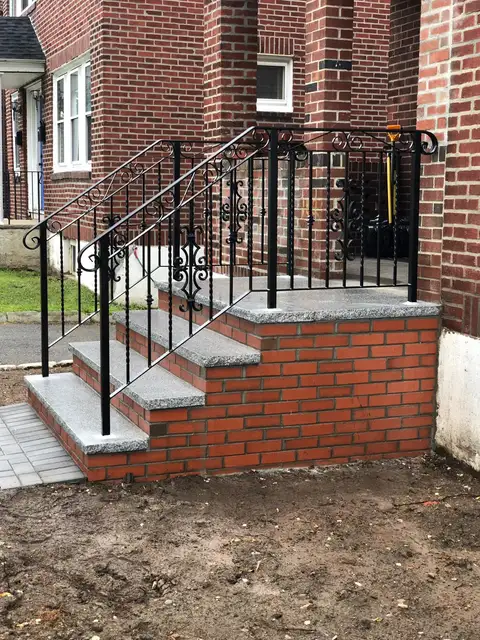
Exterior railing restored and reinstalled
The existing exterior steel railing was taken off, cleaned and prepped, welds repaired where needed, painted, and reinstalled with new anchoring hardware.
Restoration · Railings
Short answer: A wobbly or rusted iron railing can almost always be restored: the rotted post bases are cut out and replaced, cracked welds and loose pickets repaired, rust stripped and the railing refinished, then reinstalled into sound stone or concrete with new anchors.
Water sits where the post enters stone or concrete and rusts it from inside. We cut back to sound metal, splice in new post sections, and reset them.
Old anchors loosen or crack the stone. New anchors go into sound material; if the stone itself is broken, we coordinate with your mason.
Cracked welds re-welded and ground smooth; loose rivets or collars replaced.
Bent pickets straightened, missing ones and broken scrolls made to match.
Corroded top rails repaired or replaced, matching the original profile.
Primer and direct-to-metal paint as standard; hot-dip galvanizing under paint or powder coat for the longest life.
Text photos of the whole piece and the worst spots. We visit when the anchors, the stone or the extent of rust needs a closer look.
We measure and photograph so every section, scroll and finial goes back exactly where it came from.
Most restoration is done in our Everett shop, where the steel can be worked on from every side.
Down to sound metal, so we can see what is really left.
Weld cracks, straighten bends, replace rotted posts and rails, and make matching pickets, scrolls and collars for anything missing.
Primer and paint, or galvanizing and paint or powder coat, then back in place with new anchors.
Cambridge · Completed
The existing exterior steel railing was taken off, cleaned and prepped, welds repaired where needed, painted, and reinstalled with new anchoring hardware.
Revere · Completed
Two exterior ramp railings at a church were mechanically cleaned and rust-treated, loose joints and posts re-welded, deteriorated sections reinforced, then primed and painted matte black.
Everett · Completed
An exterior railing came off and went to our shop: damaged sections replaced, the rest welded and straightened, primed and painted black, then reinstalled with new anchors. A custom galvanized plate was made and installed on the same job.
Westwood · Booked
Three ornamental scroll railing sections: rust and scale removed, the corroded top rail, scrollwork and pickets repaired, each section cut and re-welded to fit a new straight run, welds ground smooth, then hot-dip galvanized and painted black over the galvanizing.
Boston · Booked
The iron railing on top of a bay window comes off so the roof can be redone. In the shop it is sanded, repaired, primed and painted, and it goes back on once the roofing is finished.
Boston · Booked
Three railing sections come to the shop for new steel posts; the middle section is extended a few inches to center the railing on its parapet curb. All sections are cleaned of loose rust and paint, primed and painted black, then reinstalled.
Many older railings are lower than a new one would have to be, or have wider gaps between pickets. Restoring an existing railing keeps its design. If the work turns into a new railing, or your building department asks for changes, today's code applies: for example, Cambridge's permit FAQ says decks on one- and two-family homes more than 30 inches above grade need a guardrail at least 36 inches high.
When it matters for your stairs, we'll point it out at the quote, and you decide with your building department which way to go. For new railings, see exterior railings and handrails.
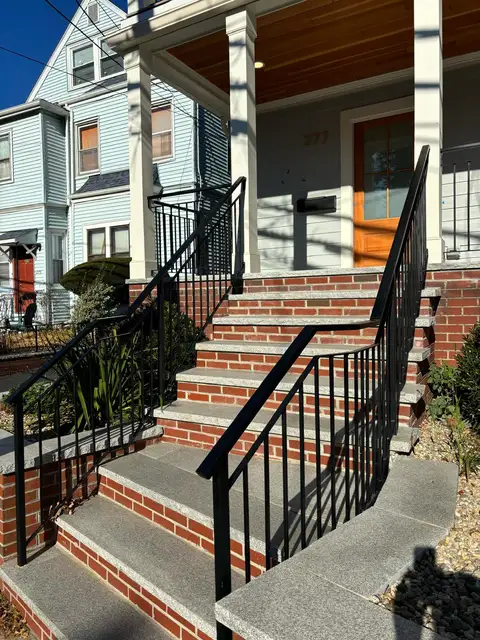
Yes. Wobble usually comes from a rusted post base or a loose anchor. We replace the rotted part of the post and re-anchor it into sound stone or concrete.
Small repairs can be done on site. Most restorations go to our Everett shop, where the railing can be stripped and worked on from all sides, then it's reinstalled.
Yes. We copy the surviving pieces and make matching ones in our shop.
It depends mostly on the finish and on salt and water. Galvanizing under paint or powder coat lasts the longest; touching up chips every year helps any finish.
Most railings made in the last several decades are mild steel; older ones may be wrought or cast iron. We check when we look at it, because it changes how we repair it. See wrought iron vs. steel.
Season-by-season upkeep for exterior ironwork.
Matching new railings to old buildings.
New railings for stairs, porches and decks.
Choosing the finish.
Railings in Boston's historic districts.
Pipe and wall handrails.